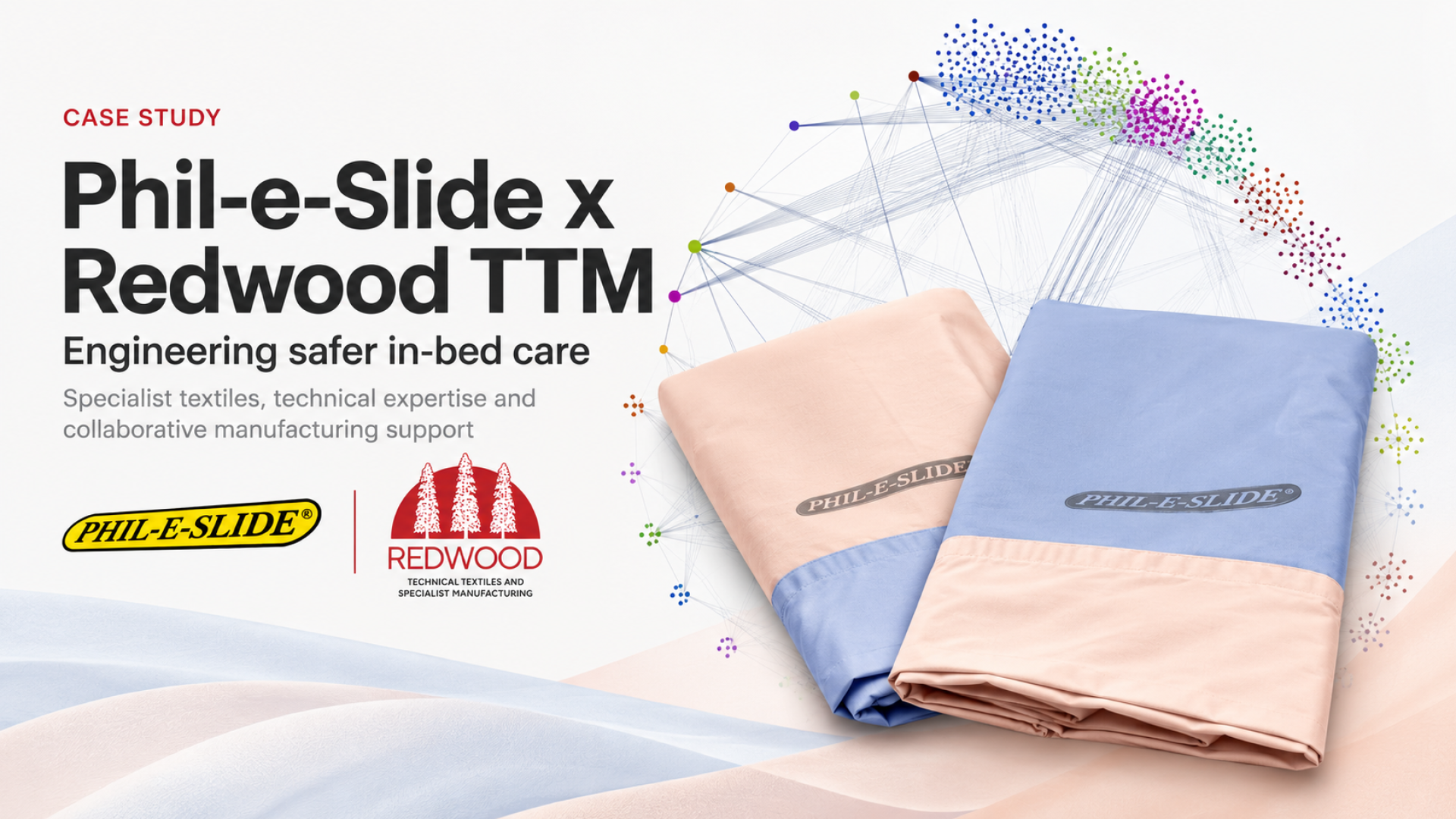
How Redwood TTM Helped Bring Phil-e-Slide’s Healthcare Innovations to Life
Published 26th October 2026
Developing a specialist healthcare product requires more than finding a manufacturer capable of following a specification. When performance depends on the interaction between materials, construction and the way a product is used, technical understanding and collaboration become just as important as production capability.
That was particularly important for Phil Strong, founder of Phil-e-Slide, the company behind the Biotechsis® inbed care system.
Drawing on decades of healthcare experience, Phil has developed a range of products designed around the challenges associated with moving, repositioning and caring for people in bed. With specialist textile construction fundamental to how these products work, Phil needed a manufacturing partner that could understand the thinking behind his designs and help translate those ideas into practical products.
That partner was Redwood TTM.
Finding the right manufacturing partner
When Phil first began working with Redwood, he wasn't simply looking for somebody to make an existing product.
He wanted a manufacturer with knowledge of specialist materials and the technical capability to understand why particular fabrics, finishes and constructions were being specified.
Wherever possible, UK manufacture and British-sourced materials were also important to him.
For Phil, the relationship needed to be collaborative.
“It was about the synergy between me and whoever was manufacturing it – understanding the nuances of what I was trying to achieve.”
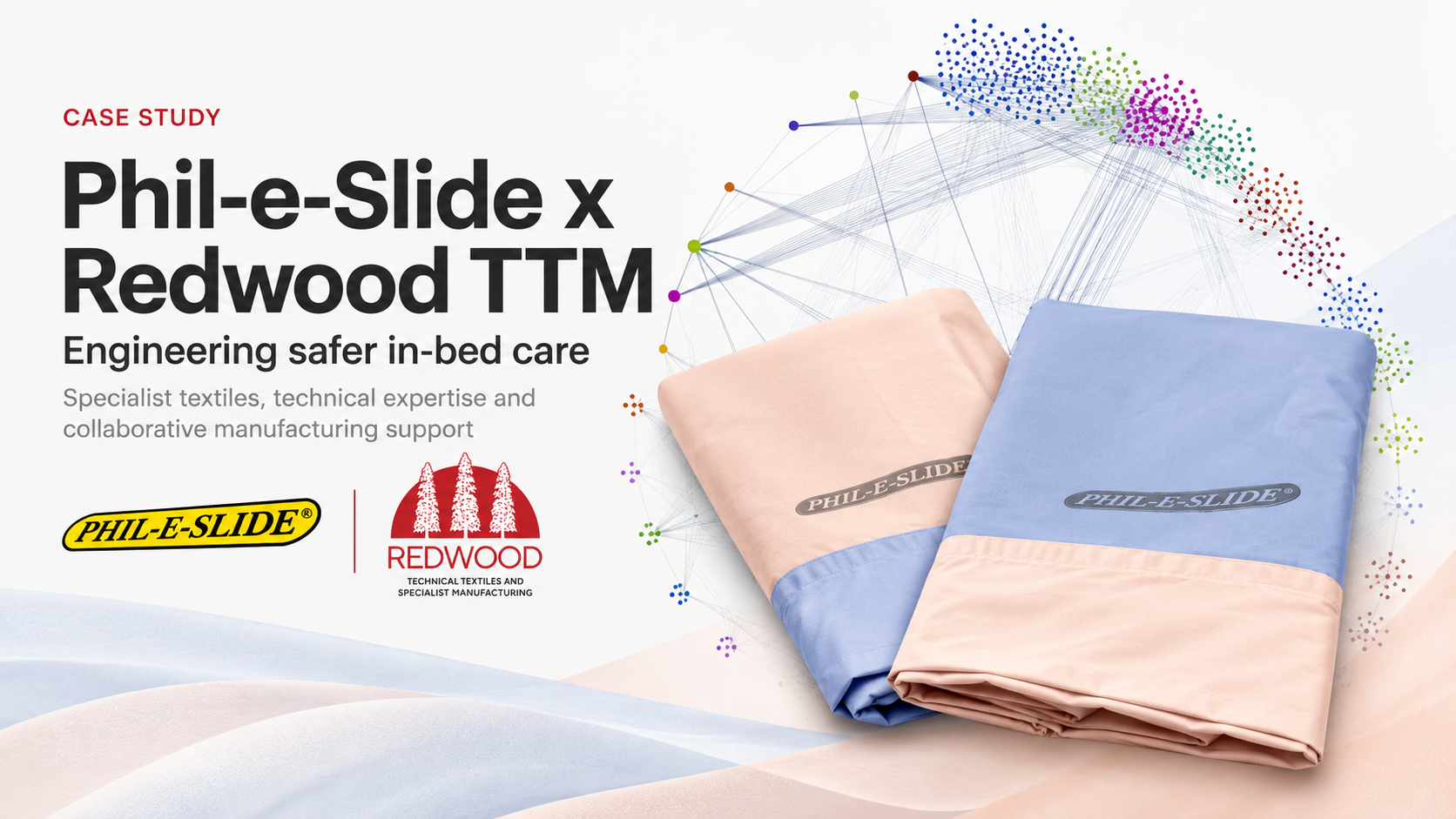
Redwood's experience in technical textiles, coatings, material conversion and specialist manufacture provided the foundation needed to take those requirements and develop practical manufacturing solutions.
Understanding the product, not just the specification
At the heart of Phil-e-Slide's product development is an understanding of how different surfaces interact when a person is moved or repositioned.
The Biotechsis® inbed care system includes products designed to work together, with particular attention paid to stiction, friction, shear and the movement between textile surfaces.
This makes seemingly small manufacturing decisions particularly important.
Material choice, the direction in which fabric is cut, the way two surfaces interact, seam construction and the positioning of individual components can all influence the performance of the finished product.
Phil brought the healthcare knowledge and an understanding of what he wanted the products to achieve. Redwood brought the technical textile and manufacturing knowledge required to determine how those ideas could be produced effectively.
It is that exchange of expertise that Phil particularly values.
“I need a manufacturer to understand where I'm coming from and be able to say, ‘You can do this, this and this.’ Then we can develop it and prototype it until we get it right.”
Solving a specialist mattress-cover challenge
One example of this collaborative approach can be seen in the development of a specialist mattress cover within the product range.
Phil wanted to create a mattress cover incorporating a surface that could provide the required sliding characteristics in a specific area, while retaining the properties needed elsewhere on the cover.
For a product intended for healthcare environments, the construction also needed careful consideration. Introducing additional layers or inappropriate seams could affect practicality, cleaning and infection-control requirements.
Working together, Phil and Redwood explored how the required properties could be incorporated within the textile itself.
A solution was developed using material processed to provide the required low-friction characteristics on one surface while incorporating a PU-coated surface on the other.
The construction could then be brought together using welding techniques, creating a practical solution without relying upon a conventional sewn seam in the critical area.
For Phil, this is a good example of what he looks for from a manufacturing partner: taking an idea, understanding the reason behind it and then using technical knowledge to establish how it can actually be made.
Manufacturing details that matter
Product development has also involved considering how fabrics are orientated and cut.
In some applications, Phil deliberately uses material on an angle rather than simply cutting straight across the roll. This can require more fabric and create additional manufacturing complexity, but the resulting interaction between the textile surfaces can improve the sliding characteristics he is trying to achieve.
It demonstrates why specialist technical textile manufacture isn't always about finding the fastest or least expensive method.
Sometimes additional material, a different construction or a more complex manufacturing process is necessary because it contributes directly to the intended performance and longevity of the finished product.
Redwood's role is to understand those requirements and establish how they can be incorporated into a repeatable manufacturing process.
Turning ideas into manufacturable products
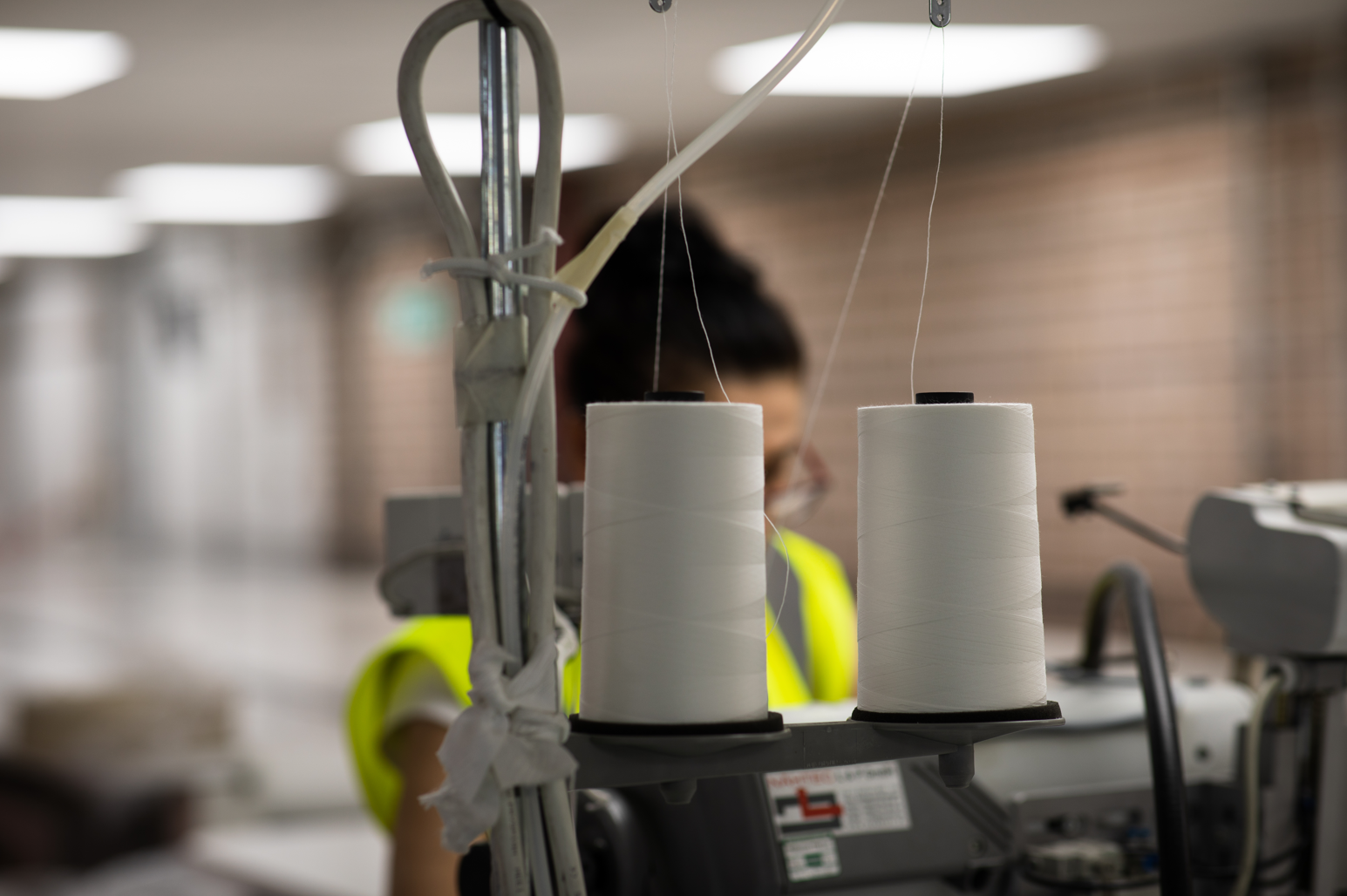
Throughout the relationship, Redwood has helped translate Phil's concepts into production by advising on areas including material selection, textile construction, cutting, coatings, welding, seams and component positioning.
Ideas can be discussed before prototypes are developed and refined, enabling potential manufacturing challenges to be considered before progressing into production.
For an innovator such as Phil, this technical dialogue is particularly valuable.
He knows the healthcare environment, understands the problems he wants to address and has a clear idea of how he wants a product to perform.
Redwood provides the manufacturing knowledge needed to help bridge the gap between that concept and the finished textile product.
Quality and consistency
Once a specialist product moves from development into manufacture, maintaining consistency becomes essential.
Asked about his experience of Redwood's manufacturing quality, Phil was clear:
“The quality and consistency have been very good.”
Although complex products can inevitably present occasional manufacturing challenges, being able to identify, discuss and resolve those issues forms an important part of an ongoing manufacturing relationship.
Proudly manufactured in Britain
UK manufacture is also important to the Phil-e-Slide story.
Phil actively promotes the fact that his products are manufactured in Britain and is happy for Redwood's role in their manufacture to be recognised.
“I've got no problem with people knowing that Redwood manufactures my products. In fact, I'd rather that happen. I'm always pushing the fact that my product is manufactured in Britain.”
For Redwood TTM, the partnership demonstrates how UK technical textile manufacturing can support specialist businesses developing products for demanding healthcare applications.
Continuing to develop
The relationship between Phil-e-Slide and Redwood is continuing, with further discussions around new product development and ways in which technical textile solutions could support the next stage of Phil's work.
The ambition is to bring Phil's product and healthcare knowledge together with Redwood's technical and manufacturing expertise once again, creating a collaborative approach to future development.
For Redwood, it demonstrates exactly what specialist manufacturing can look like when the manufacturer becomes part of the development process rather than simply the final stage of production.
Have an idea that needs turning into a manufacturable textile product?
Whether you have a finished specification, an early prototype or simply a problem you're trying to solve, Redwood TTM can work with you to explore materials, construction and manufacturing methods to help turn your concept into a practical product.
Talk to Redwood TTM about your next technical textile project.